
This article relates to Goal 1: No poverty, one of the 17 UN Sustainable Development Goals. Goal icon by the United Nations. Emberoot is not affiliated with, or endorsed by, the UN.
SDG 1, no poverty, is the first of the 17 Global Goals the UN adopted in 2015, and it is the one most of the others lean on. Its official wording is short: “end poverty in all its forms everywhere”. In practice it means ending extreme poverty by 2030, halving poverty as each country defines it, and putting safety nets under people so one bad harvest or hospital bill does not push them back under the line. According to the UN Sustainable Development Goals Report 2026, about 826 million people still live on less than $3.00 a day in 2026. That is roughly one person in ten, and the rate has fallen by only 3 percentage points since 2015.
What SDG 1 no poverty actually asks for
The goal has seven targets, listed on the UN DESA goal page. Five set outcomes and two describe the money and policies needed to reach them.
- 1.1 End extreme poverty for everyone by 2030.
- 1.2 At least halve the share of people in poverty in all its dimensions, using national definitions.
- 1.3 Build social protection systems, including minimum floors, that cover most poor and vulnerable people.
- 1.4 Give poor people equal rights to land, property, basic services, technology and financial services.
- 1.5 Make poor households more resilient to climate extremes, disasters and economic shocks.
- 1.a Raise money from many sources, including aid, so developing countries can fund anti-poverty programmes.
- 1.b Set policies that are pro-poor and gender-sensitive.
One detail trips people up. Target 1.1 still mentions $1.25 a day, because that was the World Bank line in 2015. The Bank has updated the line several times as prices change, and since June 2025 it uses $3.00 a day in 2021 purchasing power parity terms. The higher line moved the global count up, which is why recent figures look worse than older ones even where living conditions did not change.
Where the world stands
There is some good news. In 2023, 52.4% of the world’s population received at least one social protection benefit, up from 42.8% in 2015, the first time more than half were covered. Working poverty fell from 11% of employed people in 2015 to 7.9% in 2025, and Central and Southern Asia cut its rate from 15.9% to 5.2% over the same period. Old-age pensions now reach 79.6% of people above retirement age.
The gaps are just as clear. Unemployment protection covers only 16.7% of unemployed people. About 3.8 billion people had no benefit of any kind in 2023. And poverty is concentrating: the 2026 report says 71% of the world’s extreme poor now live in sub-Saharan Africa, where around 40% of workers are poor despite having a job.
What is off track
On current trends, about 9% of the world will still be in extreme poverty in 2030, so target 1.1 will be missed. The 2025 edition of the report found that only one in five countries is on track to halve its national poverty rate, the test set by target 1.2.
Money is moving the wrong way too. Aid grants aimed at poverty reduction fell 8.7% in 2024 to $19.1 billion, back to 2015 levels and equal to just 0.02% of donor countries’ national income. Guaranteeing basic social security floors in low- and middle-income countries would need about $1.4 trillion more each year, according to estimates for 2024 cited by the UN Goal 1 page. Conflict, debt and climate shocks make each of these harder.
Why it matters beyond the numbers
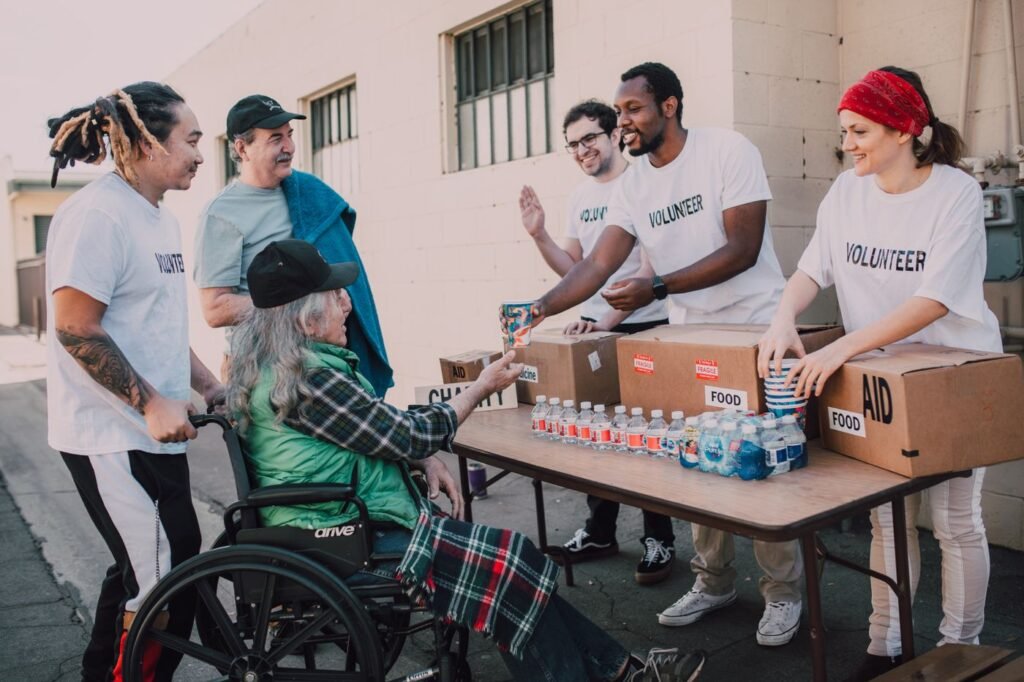
Poverty is rarely just low income. A family below the line can be forced to pull children out of school, skip treatment, borrow at punishing rates or sell what little it owns when a flood or illness arrives. That is why targets 1.3 to 1.5 focus on safety nets, rights and resilience rather than on income alone.
For businesses, poverty sets the size of future markets and the reliability of supply chains, and many of the most useful responses sit inside ordinary decisions on pay, hiring, sourcing and product design. We set those out in a separate guide, and the Goal 1 page collects the data, targets and actions on one page. If you are working out where a social goal fits in your own plans, our strategy work starts with exactly that question. You can also browse all 17 goals from the Global Goals hub.
Frequently asked questions
What is the international poverty line in 2026?
The World Bank’s international poverty line is $3.00 per person per day, measured in 2021 purchasing power parity prices. It replaced the $2.15 line in June 2025. The UN uses it to track target 1.1, even though the target text written in 2015 still mentions $1.25 a day. Countries also keep their own national poverty lines, set for local living costs.
Is SDG 1 on track for 2030?
No. The UN’s 2026 report expects about 9% of the world to remain in extreme poverty in 2030, and the 2025 edition found only one in five countries on track to halve national poverty. Social protection coverage has improved, passing half the world’s population in 2023, but funding gaps and falling aid are slowing progress.
What does ‘poverty in all its dimensions’ mean?
It means looking beyond income to things like schooling, health, housing, clean water and electricity. A household can earn just above the money line and still go without several of these. Target 1.2 asks countries to halve poverty measured this way, using their own national definitions, so the exact measures differ from one country to another.